Author Archives: Alan Rhoda

Responding to Craig and Hunt (Part 1 – Preliminary Considerations)
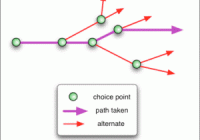
With this post I begin a series in which I respond to a 2013 paper by William Lane Craig and David Hunt. Entitled “Perils of the Open Road,” the paper critiques two papers defending open theism. More specifically, they critique a 2006 paper that I co-wrote with Greg Boyd and Tom Belt entitled “Open Theism,… Read More: Responding to Craig and Hunt (Part 1 – Preliminary Considerations) »


Lydia McGrew on Divine Timelessness (Part 3 of 3)

This is the final installment in a three-part commentary on philosopher Lydia McGrew’s essay on divine timelessness published in the latest volume of The Christendom Review. In part 1 of this series, I critiqued three of her arguments in favor of divine timelessness. In part 2 I looked at her responses to two categories of… Read More: Lydia McGrew on Divine Timelessness (Part 3 of 3) »

Lydia McGrew on Divine Timelessness (Part 2 of 3)

This post is the second in a three-part commentary on philosopher Lydia McGrew’s essay on divine timelessness published in the latest volume of The Christendom Review. In part 1 of this series, I critique three of her arguments in favor of divine timelessness: arguments based on divine transcendence, immutability, and perfection. In part 3, I… Read More: Lydia McGrew on Divine Timelessness (Part 2 of 3) »

Lydia McGrew on Divine Timelessness (Part 1 of 3)

In the latest volume of The Christendom Review, philosopher Lydia McGrew presents a three-fold argument in favor of divine timelessness. This is the view that God is absolutely immutable (cannot change in any respects) and exists in a manner that is completely unqualified by temporal predicates. On this view God doesn’t have a history or… Read More: Lydia McGrew on Divine Timelessness (Part 1 of 3) »

Alethic Openness and Bivalence (Part 2 of 2)

In my previous post I briefly presented a reason, one having to do with the need to avoid fatalism and accommodate future contingency, for thinking that the future is alethically open, or such that there is no complete, true, linear story of the future.  I then noted that we can make sense of alethic openness by supposing that… Read More: Alethic Openness and Bivalence (Part 2 of 2) »

Alethic Openness and Bivalence (Part 1 of 2)

By the alethic openness of the future I mean that there is no complete, true, linear story of the future. The main motivation for believing that the future is alethically open comes from future contingency. If the future is not alethically open but alethically settled, then there is a complete, true, linear story of the future. But,… Read More: Alethic Openness and Bivalence (Part 1 of 2) »

What Is Open Theism?

In 2008 I published a paper called “Generic Open Theism and Some Varieties Thereof” (Religious Studies). My stated goal in that paper was to “facilitate ongoing dialogue between open and non-open theists” by making precise what “minimal set of commitments any open theist, qua open theist, must affirm.” I thus advocated, and still advocate, for… Read More: What Is Open Theism? »

On Biblical Inerrancy

When most Christians speak of Biblical “inerrancy” they have in mind what could more accurately be called “strong” or “dogmatic” inerrancy. It is a kind of methodological stance, amounting to something like this: strong inerrancy (SI) = If something in the Bible looks implausible or mistaken, then either you haven’t understood it properly, you have… Read More: On Biblical Inerrancy »

The Modal Openness of the Future

There’s a simple and valid argument for fatalism based on a proposition which most analytic philosophers would accept. The assumption is this There is an actual world, alpha, which contains a complete history. Unlike other merely possible worlds, alpha is the possible world that “obtains”. For the sake of argument I take this assumption for… Read More: The Modal Openness of the Future »